Praga: Warsaw’s Unrebuilt District (And Why You Should Go)
Across the Vistula sits the one part of Warsaw the war didn’t flatten. A Warsaw guide’s tour of Praga: Orthodox domes, courtyard shrines, the legendary bazaar, the vodka factory, and the streets that still look like 1939.
Almost everything you see on the west bank of the Vistula is a reconstruction. The Old Town, the New Town, the Royal Castle, the churches: all rebuilt from rubble after the Germans flattened Warsaw in 1944. Cross the river to Praga and the city changes completely. The buildings are real. The bullet holes are real. The pre-war soul that the rest of Warsaw lost is still here, slightly battered, still trading.
Praga is the Warsaw most travelers never see. It’s gritty, proud, and increasingly fashionable in a way that hasn’t yet cleaned out what makes it interesting. Here’s what to know before you go, and what to see when you do.
Why Praga survived when the rest of Warsaw didn’t
After the Warsaw Uprising failed in autumn 1944, Hitler ordered the city erased. Specialized German Verbrennungs- und Vernichtungskommando units went block by block on the left bank, dynamiting buildings, burning what wouldn’t blow up, leveling everything. By January 1945, roughly 85% of Warsaw west of the Vistula was gone.
Praga, on the east bank, was a different story. Soviet troops arrived in September 1944 and occupied the district before the Germans could implement the same destruction plan there. The retreat was too fast. Praga survived the war with most of its 19th-century building stock intact: tenements, factories, churches, courtyards, breweries. It’s the only part of Warsaw where you can see what the whole city looked like before September 1939.
St. Mary Magdalene Cathedral, the Russian story
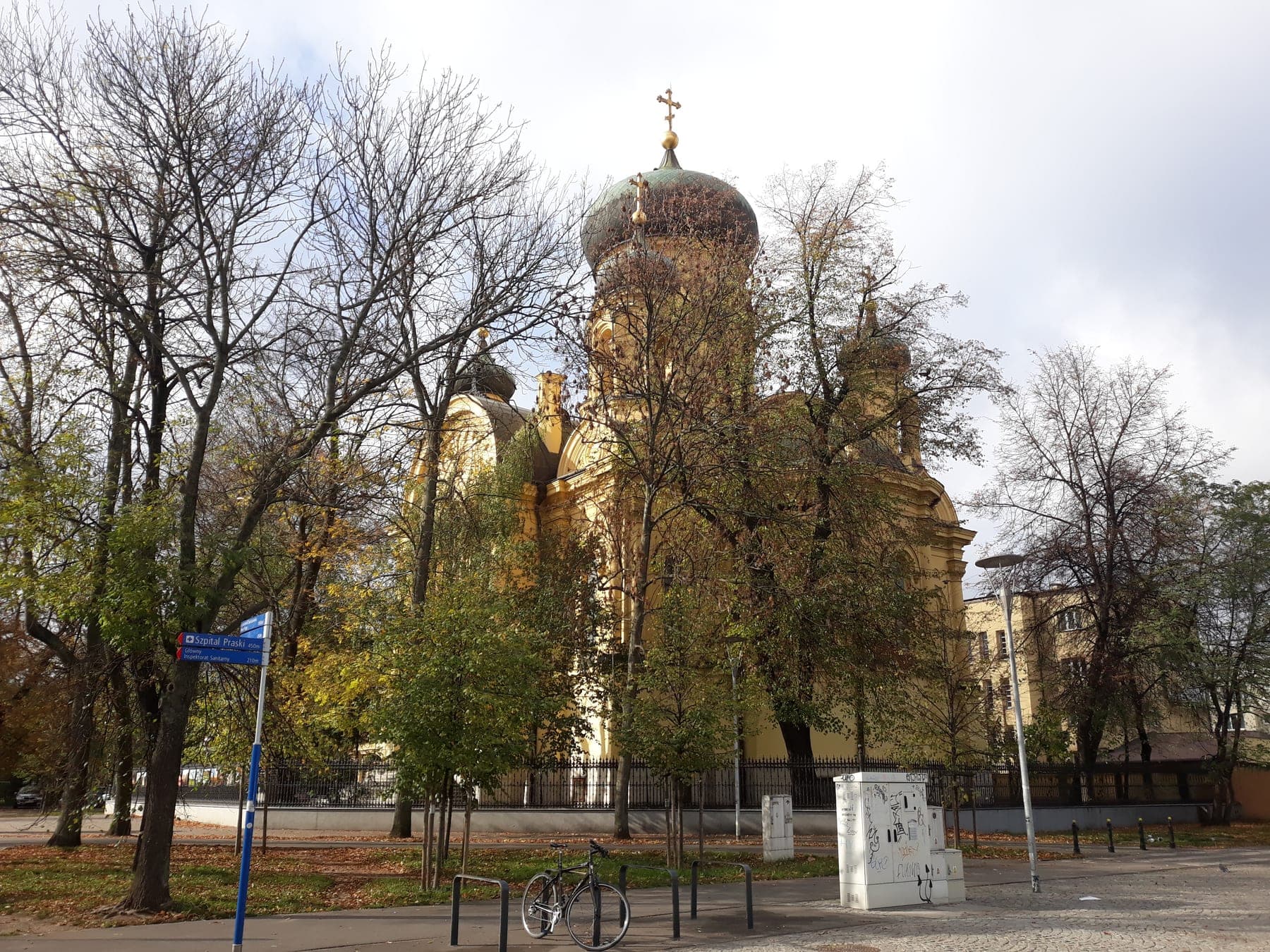
Start at Wileński Square. The pale yellow building with five green-and-gold onion domes is the Cathedral of St. Mary Magdalene, built in 1869 for Warsaw’s Orthodox community during the Russian occupation of Poland. It’s the most visible architectural reminder that for 123 years (1795 to 1918), Poland didn’t exist as a country, and Warsaw was a Russian provincial capital.
Step inside. The interior is dark, gilded, candlelit, and completely unlike any other church in Warsaw. The iconostasis (the wall of icons separating the nave from the altar) is original, from the 1860s. There’s often a service running, with Old Church Slavonic chanting that fills the whole vault.
Targowa Street, the spine
Walk south from the cathedral down Targowa, one of Praga’s oldest streets. The tenements (kamienice) on both sides are mostly original pre-war, four to five stories, ornate balconies, sometimes still bearing the names of long-dead merchants painted on the upper floors. Look closely at the ground-floor businesses. You’ll see cobblers, tailors, key cutters, second-hand shops: trades that have mostly disappeared from the gentrified left bank. Praga is still a working neighborhood, not a museum.
The buildings have a particular quality you don’t find elsewhere in Warsaw: pre-war plaster, weathered for 100 years through two German invasions, communism, and 35 years of post-1989 chaos. They look like buildings should look in old photographs. The bullet holes on some facades aren’t a reconstruction touch. They’re from 1939 and 1944, never repaired.
Różycki Bazaar, the legend
A few blocks east of Targowa is Bazar Różyckiego. It’s been operating since the 1880s, making it one of the oldest continuous markets in central Europe. In the communist era, this was the beating heart of Warsaw’s black market. Western jeans, American dollars, smuggled vinyl, scarce food, anything not available in the state shops, ended up here. Wartime kids who grew up around the bazaar got rich. Some of Poland’s post-1989 business class started behind a Różycki stall.
Today the bazaar is quieter. Polish supermarkets killed most of the food trade, and Vietnamese-Polish traders run the textile stalls. But you can still get a glass of homemade kompot, a plate of flaki (tripe soup) from a kitchen window, and a sense of what Polish street commerce looked like before EU regulations smoothed the edges.
Ząbkowska Street, the murals and bars
If Targowa is the spine, Ząbkowska is the heart. Two long blocks of pre-war tenements, with the most visible street art in Warsaw (huge wall-sized murals by Polish and international artists), vodka bars that have been there for 50 years, hipster cafés, a kosher restaurant in a former Jewish prayer house, and tenement courtyards you can walk through if a door is open.
The thing about Ząbkowska is the layering. A wall might have a 2018 mural over a 1995 graffiti tag over a 1944 bullet hole over a 1900 plaster pattern. The whole street is a stratigraphy of Warsaw’s 20th century.
The courtyard shrines (kapliczki)
Praga has one piece of folk architecture you won’t see anywhere else in Warsaw: courtyard shrines. After WWII, locals built small religious altars (kapliczki) in the courtyards of their tenements, partly out of gratitude for surviving, partly because the communist government suppressed public religious life. The shrines became the spiritual centers of entire buildings. Residents tended them, lit candles, celebrated Mary’s feast days around them.
Most are tucked behind unmarked gates and you’d never know they’re there. The trick is to look up: courtyards visible through open archways often have a shrine on the back wall, decorated with plastic flowers and old portraits of the Virgin Mary. They’re the most authentically Warsaw thing you can see, and tourists never find them without a guide.
Koneser, the former vodka factory
Walk a bit further east and you reach Koneser, a complex of 19th-century red-brick factory buildings that used to be the Warsaw Vodka Distillery. This is where Luksusowa and Wyborowa were made for over a century. The factory closed in 2007 and the buildings sat empty until a 2018 conversion turned them into Praga’s biggest cultural-commercial hub.
What’s there now: the Polish Vodka Museum (worth the ticket, ends with a tasting flight you’ll actually remember), Google’s Warsaw startup campus, a few good restaurants, design shops, and one of Warsaw’s best gelato spots. The brick-and-iron architecture is preserved, which means the whole complex feels like a working factory that happens to have a museum and a coffee shop inside.
If you’re interested in Polish vodka history, the museum pairs naturally with our vodka guide - the same names you read about on the bottles are explained on the museum walls.
Where to eat in Praga
The food scene in Praga has changed faster than anything else. Old bar mleczne sit next to new bistros doing modern Polish food, sometimes on the same block. A few that have stuck around:
- Stary Dom Praga: old-school Polish home cooking, the kind of schabowy a Polish mother would approve of.
- Kafe Kicia Kocia: laid-back café-bar with good coffee in the day, vermouth in the evening.
- Łysy Pingwin (the Bald Penguin): a Praga institution, dive-y, packed on weekends, the kind of place that’s been there forever.
- W Oparach Absurdu: bookstore-café-bar combo on Ząbkowska, dark wooden interior, the perfect place to lose a Sunday afternoon.
How to actually see Praga
Praga rewards walking and a bit of context. The buildings on their own are interesting but most of the story (who lived here, what happened during the war, why this courtyard has a shrine and that one doesn’t) is invisible unless someone tells you. Two practical options:
DIY: cross the river on tram 7 or 25 from the Centrum, Wileńska metro stop drops you a five-minute walk from the cathedral. Plan three hours. Bring small cash for the bazaar. Don’t flash a camera in the courtyards without asking.
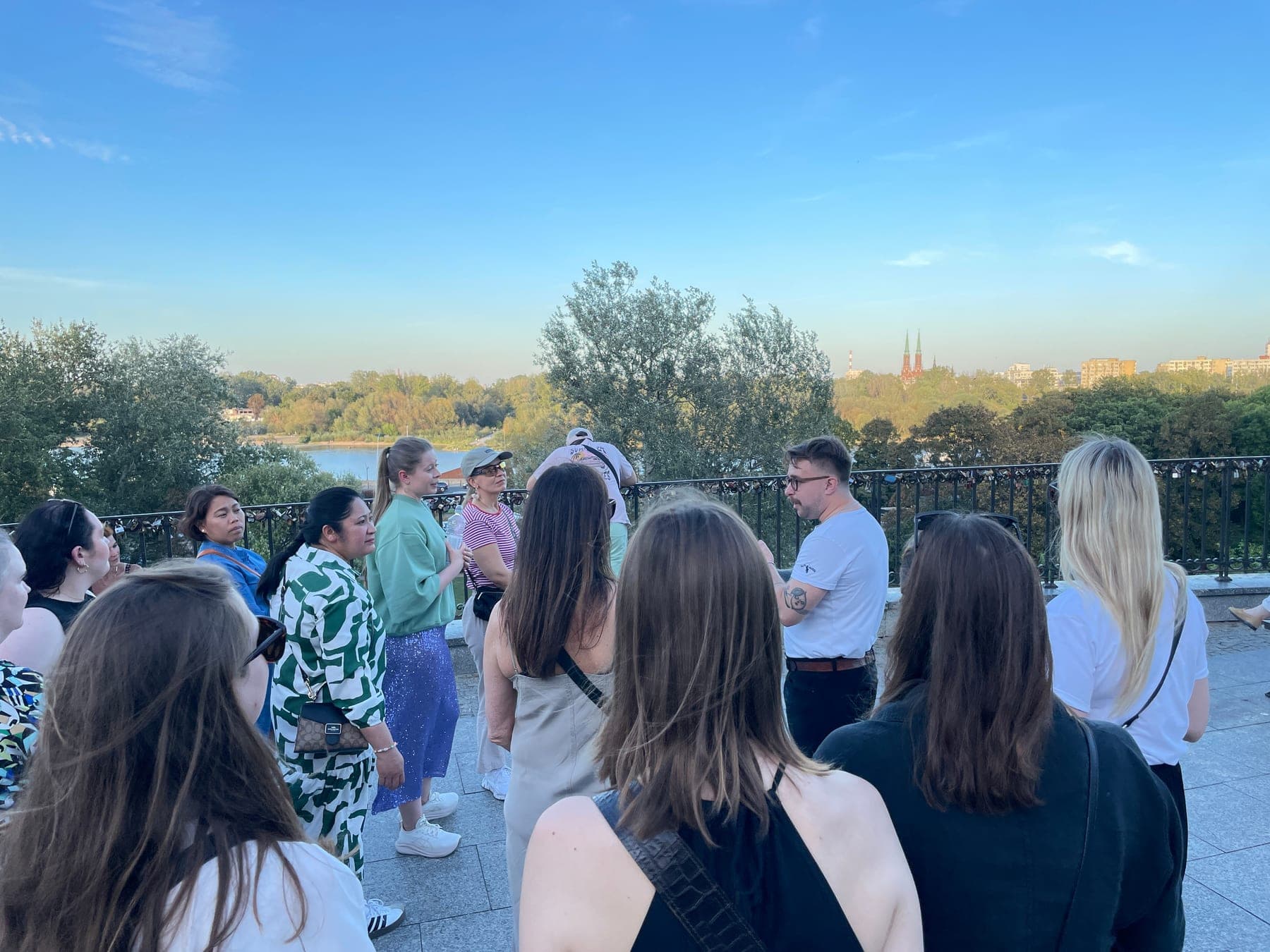
With us: our Praga Cultural Tour walks all of the above in three hours, with the stories that turn each block into context: who lived here, what changed in 1944, what the murals mean, which courtyards have shrines and why. Small group, max 8, ends at Koneser with a coffee or a vodka tasting (your call). It’s the tour we run for people who’ve already seen the Old Town and want the real Warsaw.

Guide and storyteller behind Tasty Trails' food and Praga tours. Equal parts historian and eater, happiest somewhere between a milk bar and a vodka museum.
Hungry yet?
Eat your way through this list with someone who knows the city. Small groups, real spots, no tourist traps.